Univariate Density Estimation via Dirichlet Process Mixture
[1]:
import numpy as np
import matplotlib.pyplot as plt

from pybmix.core.mixing import DirichletProcessMixing, StickBreakMixing
from pybmix.core.hierarchy import UnivariateNormal
from pybmix.core.mixture_model import MixtureModel

np.random.seed(2021)
Data Generation
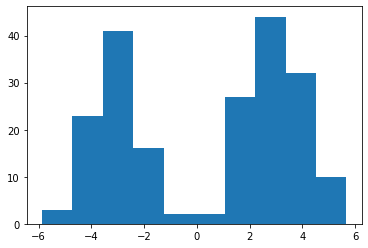
We generate data from a two-component mixture model
[2]:
def sample_from_mixture(weigths, means, sds, n_data):
    n_comp = len(weigths)
    clus_alloc = np.random.choice(np.arange(n_comp), p=[0.5, 0.5], size=n_data)
    return np.random.normal(loc=means[clus_alloc], scale=sds[clus_alloc])
[3]:
y = sample_from_mixture(
    np.array([0.5, 0.5]), np.array([-3, 3]), np.array([1, 1]), 200)
plt.hist(y)
plt.show()
The statistical model
We assume the following model
where \(DP(\alpha, G_0)\) is the Dirichlet Process with base measure \(\alpha G_0\).
Given the stick-breaking represetation of the Dirichlet Process, the model is equivalently written as
In pybmix we take advantage of the second representation, and specify a MixtureModel in terms of a Mixing and a Hierarchy. The Mixing is the prior for the weights, while the Hierarchy combines the base measure \(G_0\) with the kernel of the mixture (in this case, the univariate Gaussian distribution)
Here, we assume that \(\alpha = 5\) and \(G_0(d\mu, d\sigma^2) = \mathcal N(d\mu | \mu_0, \lambda \sigma^2) \times IG(d\sigma^2 | a, b)\), i.e., \(G_0\) is a normal-inverse gamma distribution.
The parameters \((\mu_0, \lambda, a , b)\) of \(G_0\) can be set automatically by the method ‘make_default_fixed_params’ which takes as input the observations and a “guess” on the number of clusters
[4]:
mixing = DirichletProcessMixing(total_mass=5)
hierarchy = UnivariateNormal()
hierarchy.make_default_fixed_params(y, 2)
mixture = MixtureModel(mixing, hierarchy)
Run MCMC simulations
[5]:
mixture.run_mcmc(y, algorithm="Neal2", niter=2000, nburn=1000)
Initializing... Done
Running Neal2 algorithm with NNIG hierarchies, DP mixing...
[============================================================] 100% 2.241s
Done
Get the density estimates
fix a grid where to estimate the densities
the method ‘estimate_density’ returns a matrix of shape [niter - nburn, len(grid)]
[6]:
from pybmix.estimators.density_estimator import DensityEstimator
[7]:
grid = np.linspace(-6, 6, 500)
dens_est = DensityEstimator(mixture)
densities = dens_est.estimate_density(grid)
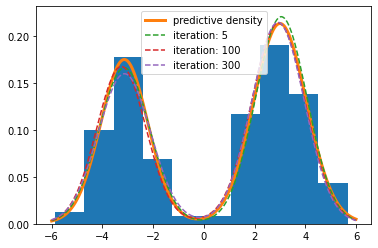
Plot some of the densities and their mean
[8]:
plt.hist(y, density=True)
plt.plot(grid, np.mean(densities, axis=0), lw=3, label="predictive density")
idxs = [5, 100, 300]
for idx in idxs:
    plt.plot(grid, densities[idx, :], "--", label="iteration: {0}".format(idx))

plt.legend()
plt.show()